

Let’s start with a scene you probably know well. Marketing runs a campaign and celebrates 300 new leads. Sales looks at the list and says the leads are poor quality. Marketing replies that sales never followed up properly. Both teams are working hard, yet the revenue number at the end of the quarter barely moves.
If that sounds familiar, take a breath, because you don’t have a people problem. You have a system problem. Most growing businesses don’t lack leads, talent, or effort. What they lack is a connected revenue growth strategy that tells every team what to do, when to do it, and who owns each step.
In this guide, we’ll look at where leads quietly disappear, how to fix those gaps, and how to build growth you can actually predict. We’ll keep it practical, so by the end you’ll have a clear plan to start with this month.
What Is a Revenue Growth Strategy?
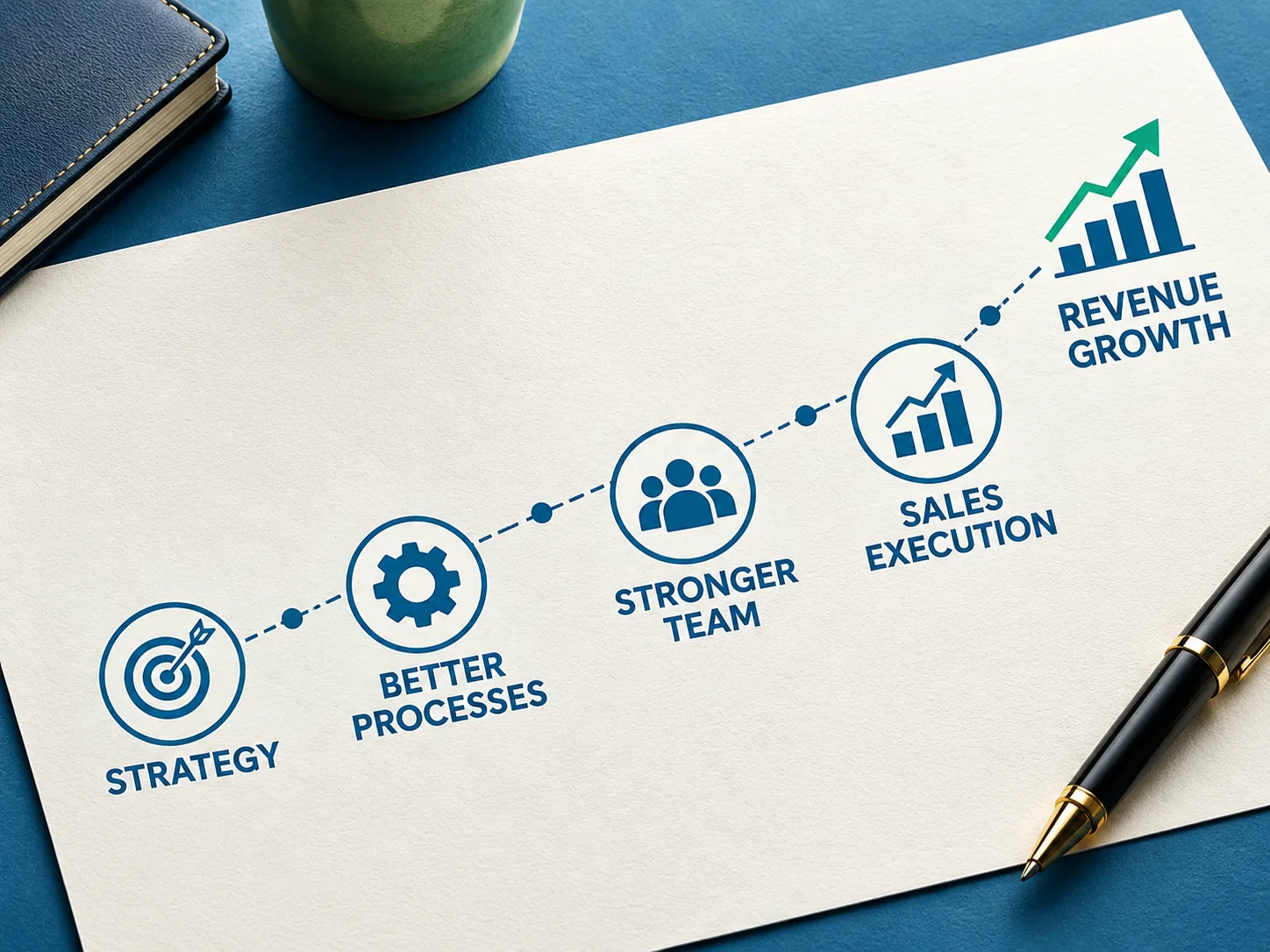
A revenue growth strategy is a documented plan for how your business attracts, converts, and retains customers in a repeatable way. It covers your ideal customer, your messaging, your lead flow, your sales process, and the numbers that tell you whether everything is working.
The word that matters most there is “repeatable”. Plenty of businesses grow through luck: a big referral, a seasonal spike, or one brilliant salesperson. That kind of growth feels great, but you can’t forecast it, and you certainly can’t scale it.
Think of a cricket team. One star batter can win you a match or two. But a team with a game plan, clear roles, and regular practice wins tournaments. A good revenue growth strategy does the same thing for your business. It turns growth from a pleasant surprise into a system.
Why Do Sales and Marketing Teams Lose Leads?
Before you fix anything, you need to know where the leak is. So here’s a question: if you traced the last 50 leads your business received, could you tell exactly what happened to each one?
Most teams can’t, and that’s the problem. In growing businesses, leads usually slip away at four points.
The handoff. Marketing generates a lead and drops it into a spreadsheet or CRM. Sales notices it two days later, or sometimes never. Speed matters a lot here, because a lead that isn’t contacted quickly goes cold quickly. The person who filled in your form this morning has probably also filled in a competitor’s form.
The definition of a “good lead.” Marketing counts every form fill as a lead. Sales only counts someone with a budget and a real deadline. Without a shared definition, both teams are technically right, and both are frustrated. This single disagreement causes more conflict than almost anything else.
The follow-up. Many prospects aren’t ready to buy today, but they would happily buy in three months. If nobody stays in touch, they drift to whichever competitor did. Most deals are lost not because the buyer said no, but because nobody was there when they were ready to say yes.
The feedback loop. Your sales team hears valuable things on every call: objections, pricing concerns, and mentions of competitors. That insight rarely travels back to marketing, so campaigns keep repeating the same mistakes while sales keeps hearing the same complaints.
None of these are dramatic failures. They’re small gaps. But small gaps repeated every week add up to a surprising amount of lost revenue.
A Quick Self-Check: Is Your Revenue Leaking?
Let’s make this interactive. Read the five questions below and count how many you answer “no” to.
Do your sales and marketing teams agree, in writing, on what a qualified lead is? Does every new lead get a response within a few hours? Can you see how many leads moved from one funnel stage to the next last month? Does sales regularly share what it hears from customers with marketing? Do both teams look at the same dashboard?
If you answered “no” to two or more, your leads are almost certainly slipping through the cracks. The good news is that these are among the cheapest problems to fix, which brings us to the next section.
Why Sales and Marketing Alignment Is the Fastest Fix
Here’s the encouraging part. Sales and marketing alignment is one of the few growth levers that costs very little but delivers results quickly. You don’t need new software or a bigger budget. You need shared goals and a shared language.
Alignment begins with one simple shift: both teams own the same revenue number. When marketing is measured only on lead volume and sales only on closed deals, each team naturally protects its own number. But when both are accountable for pipeline and revenue, the conversation changes. Instead of “your leads are bad”, you hear “what’s stopping this lead from becoming a customer?”
There are four practical ways to build that alignment.
First, define lead stages together. Sit down in one room and decide what makes a lead marketing-qualified and what makes it sales-ready. Write the definition in plain language so a new hire could understand it in a minute.
Second, create a simple service-level agreement (SLA), which is just a clear promise on response times. For example, every qualified lead gets a response within a fixed number of hours, and sales updates the lead’s status within a fixed number of days. It sounds strict, but it actually removes arguments, because everyone knows what “on time” means.
Third, hold a short weekly meeting. Twenty to thirty minutes is enough. Look at which leads converted, which stalled, and why. This one habit often does more for alignment than any workshop.
Fourth, share one dashboard. When both teams look at the same numbers, arguments about whose data is right simply disappear.
None of this is complicated. The real challenge is building the habit and holding each other to it week after week.
Building a Predictable Revenue Growth Strategy for Growing Businesses
Now let’s put the pieces together. If you’re wondering how to go about building a predictable revenue growth strategy for growing businesses, here is a six-step framework you can start using right away.
Step 1: Get clear on your ideal customer. Who buys from you most often, pays on time, and stays the longest? Look at your best ten customers and find the pattern in their industry, company size, problem, and what made them decide to buy. Everything else in your strategy is built on this foundation, so don’t rush it.
Step 2: Map the full customer journey. Draw the path from the first moment someone hears about you to the moment they buy again. Mark who is responsible at each stage, whether that’s marketing, sales, or customer success. The gaps and overlaps will become obvious almost immediately.
Step 3: Know your funnel numbers. Count how many people move from lead to qualified lead, then to a meeting, a proposal, and a closed deal. Once you know these numbers, you can work backward. If you need 10 new customers a month and your close rate is 20%, you need 50 qualified opportunities. That is what predictability looks like in real life.
Step 4: Fix the handoffs first. Before spending more on lead generation, tighten the points where leads move between teams. Plugging a leak is almost always cheaper than turning up the tap.
Step 5: Measure fewer things, but measure them consistently. Pick five to seven metrics, such as lead response time, conversion rate by stage, sales cycle length, cost per acquisition, and revenue per customer. Then review them on a fixed schedule, not just when something goes wrong.
Step 6: Review and adjust every quarter. Markets shift and customers change. Your strategy should be a living document, not a PDF that gathers dust in a shared folder.
One important point: predictability doesn’t mean growth without surprises. It means that when something changes, you see it early and respond quickly, instead of discovering the problem at the end of the quarter.
Go-to-Market Strategy for SMEs: Keep It Focused
Large companies can afford to try ten channels at once. Smaller businesses can’t, and honestly, shouldn’t. A strong go-to-market strategy for SMEs is built on focus: one clear audience, one strong message, and two or three channels that work well.
Start by asking three simple questions. Who exactly are we selling to? What problem do we solve better than anyone else for them? Where do these buyers already spend their time and look for answers?
Your answers will shape your channels. If your buyers are small manufacturers, a LinkedIn presence, industry WhatsApp groups, and direct outreach may beat expensive ad campaigns. If you serve consumers, local search and referrals might matter more. The key is to choose carefully and test before you scale, rather than copying whatever a competitor seems to be doing.
A focused go-to-market plan also makes alignment much easier. When marketing and sales share one audience and one message, the handoff feels natural, because the lead arriving at sales already recognizes the story being told.
Sales Process Improvement for SMEs: Small Changes, Big Impact
Many growing businesses run their sales on gut feel and personal style. That works when you have one great closer. It starts to break when you hire your second, third, and tenth salesperson. This is exactly where sales process improvement for SMEs pays off.
You don’t need a complicated framework to begin. Start by writing down the steps your best salesperson follows, from the first call to the signed contract. Then standardize the basics: a consistent way to qualify leads by budget, authority, need, and timeline; a clear set of pipeline stages, with a definition of what must happen before a deal moves forward; ready templates for follow-up emails, proposals, and common objections; and a simple CRM habit where every conversation is logged the same day.
Once the process is written down, training new hires becomes faster, forecasting becomes more accurate, and you can see exactly where deals tend to stall. The goal isn’t to turn your salespeople into robots. It’s to remove guesswork so they can spend their energy on the conversations that matter most.
Revenue Growth Strategy for Indian SMEs: What’s Different?
A revenue growth strategy for Indian SMEs needs to reflect how business actually happens here. Buying decisions often involve several people, such as owners, family members, and finance heads. Relationships and trust carry real weight. Sales cycles can stretch when payment terms and negotiations enter the picture. And WhatsApp is frequently a sales channel in its own right, not just a chat app.
This means your process should include a longer lead nurturing phase, where you stay in touch until the buyer is ready, strong follow-up discipline, and relationship-building touchpoints alongside digital marketing. It also means your sales and marketing teams must stay closely connected, because a prospect’s first impression of your brand and their later conversation with a salesperson need to feel like one continuous experience.
There’s another factor worth mentioning. Many Indian SMEs are founder-led, with the owner personally involved in major deals. That’s a real strength in the early years, but it becomes a bottleneck as the business grows. A documented, team-owned revenue system lets founders step back from daily selling and spend their time on strategy, which is where they add the most value.
How Mountain Monk Consulting Approaches Predictable Growth
At Mountain Monk Consulting, we work with growing businesses that have the effort and the ambition but feel stuck because their sales and marketing efforts don’t connect. Our approach starts with finding the real problem, not guessing. We look closely at your funnel, your handoffs, your data, and your team habits to find exactly where revenue is slipping away.
From there, we focus on practical systems: shared lead definitions, a clear sales process, aligned reporting, and a go-to-market plan your team can actually follow. The aim is simple. We want your growth to become something you can plan, forecast, and repeat, instead of something you hope for each quarter. That is the thinking behind our Growth, Marketing & Sales service, and it’s why leaders turn to Mountain Monk Consulting when they’re ready to move from scattered effort to structured results.
Common Mistakes to Avoid
As you build your own revenue growth strategy, watch out for a few common traps.
Don’t buy new software before fixing the process. A tool only speeds up what you already do, whether that’s good or bad. Don’t chase more leads while ignoring the ones you already have, because a warm lead you’ve neglected is worth more than a cold one you haven’t found yet. And don’t treat alignment as a one-time workshop. It’s a habit that needs regular meetings, shared numbers, and visible support from leadership.
Finally, don’t try to fix everything at once. Pick the single biggest leak, usually the handoff or the lead definition, fix it, and then move to the next one. Small, consistent wins build momentum, and momentum builds trust between your teams.
Ready to Stop Losing Leads?
Predictable growth isn’t only for big companies with big budgets. It comes from clarity, alignment, and a few good habits practiced consistently. If your sales and marketing teams are working hard but the results still feel unpredictable, the gap is probably smaller and more fixable than you think.
So here’s a simple next step: take the five-question self-check from earlier and see how your team scores. Then, if you’d like a second pair of eyes on what you find, let’s talk. Reach out to our team for a friendly conversation about your current process, and we’ll help you map out the first steps toward a revenue growth strategy that works for your business.
Frequently Asked Questions
What is a revenue growth strategy?
A revenue growth strategy is a documented plan for how your business attracts, converts, and retains customers in a repeatable way. It connects marketing, sales, and customer success around shared goals and metrics, so growth doesn’t depend on luck.
Why do sales and marketing teams lose leads between them?
Leads are usually lost because of unclear handoffs, mismatched lead definitions, slow follow-up, and the absence of a feedback loop. Fixing these four areas recovers most of the revenue that currently slips away.
How can SMEs improve sales and marketing alignment?
Start by agreeing on what counts as a qualified lead, set clear response-time expectations, share one dashboard, and hold a short weekly review meeting. Consistency matters far more than complexity.
How long does it take to see results from a revenue growth strategy?
Quick wins, such as faster follow-up and clearer lead definitions, can show results within a few weeks. Building a fully predictable system typically takes two to three quarters of steady measuring and fine-tuning.
Is a revenue growth strategy different for Indian SMEs?
The fundamentals are the same, but Indian SMEs often deal with relationship-driven buying, multiple decision-makers, longer sales cycles, and founder-led selling. A good strategy accounts for these realities from the start.
What is the difference between a go-to-market strategy and a revenue growth strategy?
A go-to-market strategy explains how you launch and present your offer to a specific audience. A revenue growth strategy is broader: it covers that plan along with your sales process, handoffs, metrics, and customer retention.
Can Mountain Monk Consulting help with sales and marketing alignment?
Yes. Mountain Monk Consulting works with growing businesses to diagnose funnel gaps, align teams, and build sales and marketing systems that support steady, predictable growth.